The Story of the Sonoma County Historical Society
The origins of the Sonoma County Historical Society trace back to the efforts of physician William C. Shipley (grandson of Forty-Niner and Sonoma County pioneer R. J. Shipley) to establish a Sonoma County Museum and Art Gallery Association in 1948. Under his leadership, and with the involvement of Burton M. Travis, William S. Borba, and Edward Fratini, the organization held regular meetings and developed ambitious plans to buy, build, or adapt space for a county history and art museum. Despite the members’ early enthusiasm and community support, as well as research visits to museums around the state, the group’s divergent interests in art and history, as well as geology and natural science led to internal conflicts. Its inability after several years of disappointments to secure a permanent site led to the group’s dormancy. Shipley went on to share his research with the California Historical Society and other scholars and to publish stories of local history widely. He died in 1960, at age 88.
In 1962, another descendant of nineteenth century settlers and an elementary school teacher, Leota (Mrs. Walter) Nagle proposed forming a new organization dedicated to preserving Sonoma County’s past. Unlike its predecessor, the new society intended a multi-pronged mission. Its goals included promoting the study and preservation of Sonoma County history and landmarks, encouraging the use of historical names for public spaces, and, when possible, supporting the creation of a museum to display artifacts, documents, and books of historical importance.
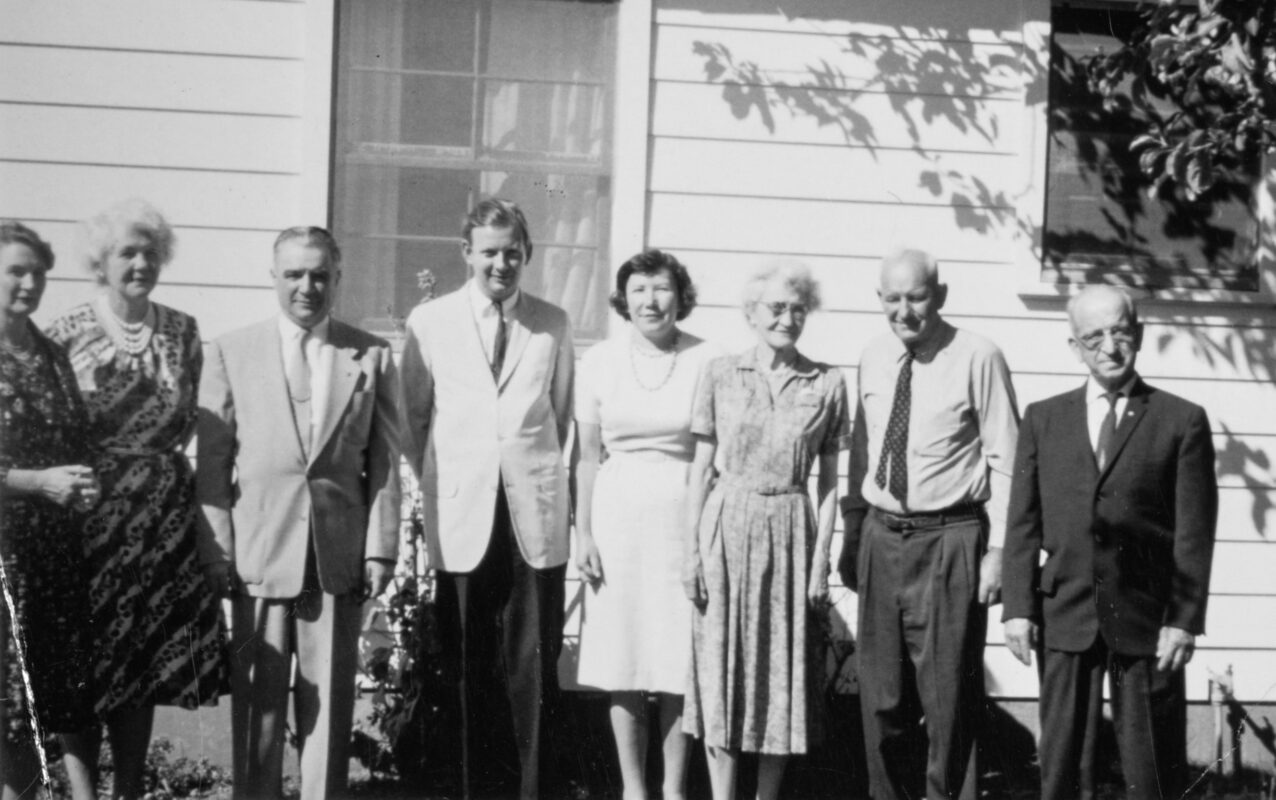
Portrait of the Sonoma County Historical Society, 1962
On June 10, 1962, eight local residents—including Messrs. Travis, Borba, and Fratini—met at the Santa Rosa home of Ann (Mrs. Edward H.) Connor and officially established the Sonoma County Historical Society. The founding officers were President Connor, Vice President Borba of Sebastopol, Treasurer Travis of Forestville, Corresponding Secretary Wanda (Mrs. William) Lippincott of Santa Rosa, and Recording Secretary Jeanne Thurlow Miller of Santa Rosa. Director/trustees included Fratini of Petaluma, Edwin Langhart of Healdsburg, and Harvey Hansen of Santa Rosa (co-author with Miller of the recently published, now classic Sonoma history Wild Oats in Eden). Nagle was made the first charter member. Regular society memberships cost $2.50 per year or $50 for a life membership.
A typewritten newsletter, called The Journal and featuring a masthead showing “The Redwood Empire’s Seven Flags,” was launched and included society news, reprinted and newly written history articles. In addition, the Rural Cemetery Association, a “branch” of the historical society formed, initially to clear roads there so that plot owners could get to their gravesites for maintenance.
Ironically, the long-deferred museum quickly became a reality.
In 1963, Ruby Jewell Codding-Hall and her son real estate developer Hugh Codding—through the Codding Foundation, an educational and cultural trust—offered the society shared use of a recently vacated building owned by Codding at 557 Summerfield Road. It was situated opposite what would soon be the tennis courts at Howarth Park in Santa Rosa. The rent was set at $1 per year. (The rest of the building housed Codding’s extensive collection of big game trophies and other artifacts that later became the Petaluma Wildlife & Natural Science Museum on the Petaluma High School campus.)
The society issued a public call for donations and in flowed bits of history, large and small, from drawers and cabinets, closets and cupboards, garages and barns: antique eyeglasses, jewelry; letters, diaries, postcards, photographs, receipts, probate documents, souvenir booklets; geological specimens, chamber pots, toys, farming tools and kitchen utensils; a brass shotgun shell, one cap loader, wad cutter and a leather powder flask—on loan; dresses, baby shoes, quilts, coverlets and other linens; furniture, clocks, books, art, and atlases.; one microfilm machine and 20 rolls of film.
Volunteers numbered, labeled, and organized the windfall the best they could and prepared the exhibit space.
The museum officially opened to the public with free admission on January 19, 1964. Erle C. Rogers, a retired dentist, historian, and descendant of two pioneer families, and his wife, Laberta, volunteered to greet the public each Sunday afternoon. Those signing the guest book in 1964 numbered some 600. The following year the number doubled.
That same month, 86 of the society’s 220 members and their guests met in the Branding Room of Coddingtown’s Saddle and Sirloin restaurant for the society’s first annual dinner. There, three people were elected honorary life members: Sonoma Valley history and Vallejo scholar Madie Brown, (her soon-to-be-husband) Richard Raoul “Dal” Emparan, and Mrs. Arthur Allen. Emparan, for many years a curator with Brown at Lachryma Montis, was the grandson of Mariano Vallejo. Mrs. Allen, better known today as “Elsie,” was acknowledged as an important Pomo leader and culture bearer.
At the society’s second annual dinner, held January 15, 1965, also at the Saddle and Sirloin, new officers were elected: President Borba, Vice President Fratini, Treasurer Travis, Corresponding Secretary Ann Connor, and Recording Secretary Edwin Langhart. Trustees included Dr. Rogers, Audra (Mrs. James) Weed, Eva (Mrs. Cecil) Fewel, Everett Chaney, Lillian (Mrs. Robert) McClelland, Edna Cooper, and authors Jeanne Miller and Harvey Hansen.
Over the course of that year, the society incorporated as a nonprofit organization and grew to nearly 300 members. Journal editor, newly elected secretary and past-president Connor organized a 160-page illustrated softcover book called Tales of Sonoma County, containing stories previously written by the late Dr. Shipley and published in the Healdsburg Tribune in 1938. This was the first of several publications that would be sponsored by the historical society over the years. Burton Travis in his 1965 history of the society noted that Connor’s “energy and determination inspired others to contribute to the cause.”
Soon it became clear to society leaders that staffing the museum only with an assortment of volunteers was inadequate to the site’s popularity and to the society’s professional-level ambitions; they needed a full-time, paid director. The county Board of Supervisors declined to fund the position. The community was asked to write letters in support of the idea and to volunteer to lighten the load of those already holding the facility together.